You can use your Bluesky account to reply to this post.
(Learn how this is implemented here.)
The Binary Star Promise is that I will get a great idea for a prototype, start something, and put it on the backburner for a bit if it’s something I don’t owe people and would need a lot of legwork. Valiant Horizon Tactics is, indeed, no exception to this. But thanks to having a genuinely atrocious week and needing a little pick-me-up, I decided I’d start thinking about it again because I do like the concept a lot.
Valiant Horizon Tactics is a RUNE hack. One reason I kind of fell off on it is because I’d hit a point where I wasn’t sure about the approach. Early on I decided to glom this onto Valiant Horizon conceptually, and that was a decent idea, but with that brings some expectations from Valiant Horizon which clash with things I like a lot in this design such as:
Thinking about it more, I decided it needed to be two games.
There’s also a few things I’m probably not bringing back immediately in either iteration:
- Quick vs Normal vs Slow actions. (Well I guess the proper VHT described above effectively has action priority in the same way that REAP would, but it’s different.) It’s a neat idea but the process flow needs more extra steps than I’d like and I started having to think about things like order of operations and edge cases in resolution (can a Block be slow? Can a Move be slow? When is the target of a Slow Strike declared?) and I realized this was starting to become a red vs blue function kind of thing. So instead of being a core mechanic that comes up a lot, this can just be something that slips in as a keyword now and then and complicates things situationally.
- Invoke as a thing equipment can do to use Powers, Spells, that kind of external-to-equipment Ability. Instead of taking an action that in turn takes an action, I just want to do the thing directly. (Also this makes certain object relations really weird - more on this later.) I might want things to interface with Powers/Spells somewhat but probably not in that particular way.
- I’m still not 100% sure what I want to do with in-combat consumables. Souls games are kind of weird about them in a way that I don’t want to replicate. Nobody ever uses shit if it feels like you can run out and it can be wasted on a boss fight!
As we’ll see though, I’m bringing back some stuff I left behind before.
Now, one thing I really wanted to keep thinking about in this space was the idea of healthlessness (as described in Devlog #1). Both enemies and players have no tracked health. The original idea was a kind of experiment in it. Did that experiment work and do I want to keep going with it?
I recently released NULL_SPACE, in which I leveraged a lot of the Healthless concepts developed for VH Tactics originally for challenges and especially complex challenges (in that they respect the Preparation/Cleverness/Execution trio). Players, however, are emphatically not healthless.
This makes perfect sense: a player and a challenge have very different levels of resolution. The more I thought about it, what I settled on was wanting this hybrid approach. Your player character tracks Health, but your equipment has Strike (potentially with keywords) and numbered Block values. Enemies do not track Health, but their attacks have numbered Harm values.1
This has a few nice side effects.
I love how the VHT hexmaps turned out! They’re fun to write and fun to explore. (Or at least I think so.) I think I made a good case to myself justifying why they’re like that instead of a more concise pointcrawl: the value of having needles in the haystack is apparent to anyone who’s played an open-world game. I don’t think they’re a 100% substitute for RUNE/REAP-like pointcrawls, though, in much the same way that Elden Ring’s overworld didn’t prevent them from putting legacy dungeons in. So how do we combine these two ideas?
This is hopefully not going to blow any minds because this is how basically every big hexcrawl style thing does this: My proposed use of this sort of hexmap for this, as you might have guessed by that example above, is to serve as a kind of “overworld”, while “dungeons” use the pointcrawl format. I can still do the same stamina-attrition stuff as VHT on the hexmap, but we can drill down and do more specific stuff within a pointcrawl. Additionally, right now VHT maps are kind of separate from each other - if we’re doing this thing, they gotta be stitched together into one coherent, seamless overworld map (if still separated by regions).
One thing I do want to bring back from RUNE/REAP is the concept of Lore, a quantified resource of how much you know about a Realm. I don’t want it to quite do the same thing as in RUNE/REAP, though. I want it to work on the hexmap level instead. Lore is tracked per-region and means you know that area of the map well: it lets you enter places you didn’t know about, find things you wouldn’t be able to otherwise, do things you’d have to learn elsewhere, or do things like find a second entrance to a known location. You gain it by exploring the area, finding landmarks, and/or getting information from people. (It might not be called Lore later because this seems like it’s getting slightly far afield from the original concept, but it’s the same idea.)
Now what do we get out of exploration? Well, aside from just throwing stuff everywhere - which is also good, for the record - one plan is to reintroduce abstracted currency. WYRM gets around a lot of the fiddliness of money that I dislike by quantifying it into Tier X Treasures. I’m not really interested in pure tiered upgrades as such so numeric tiers are kind of whatever here, but I want to use them as Minor Treasure, Major Treasure, and Exceptional Treasure. Lumping them as Treasure means I can add a descriptive aspect to each of them, which is flavorful and everyone loves that. Also because people value different kinds of things more, that flavor qualitative aspect can matter: maybe a particular person treats certain kinds of Minor Treasures as Major for the purposes of selling things, or someone only accepts certain kinds of Treasure in exchange for their goods.
Now then. Let’s talk about how complicated a character can be in each of these kinds of games. I made flowcharts. (I’m so sorry.)
RUNE, REAP, and VHT are very combat-heavy games. Whatever this is will be no exception, so we gotta talk about the combat loop and how loadouts affect it. The kinds of things I care about in this case are:
For the sake of my own interest, I’m also choosing to care about the window of how long an input matters:
For RUNE/REAP I’m going by the main book only, not Realms. Once you get to Realm equipment that becomes a game of “did everything that’s out there follow these design patterns2” and I don’t feel like playing whack-a-mole. Plus, I think it’s helpful to establish what the base parameters even are: things can always change in an exception-based manner later, but what is the basic expectation before they balloon out? Also I’m just not going to worry about consumables because that’s also very Realm-dependent, it’s not something you can bank on for a resource model.
So using these conceptual parameters, original RUNE looks like the following:
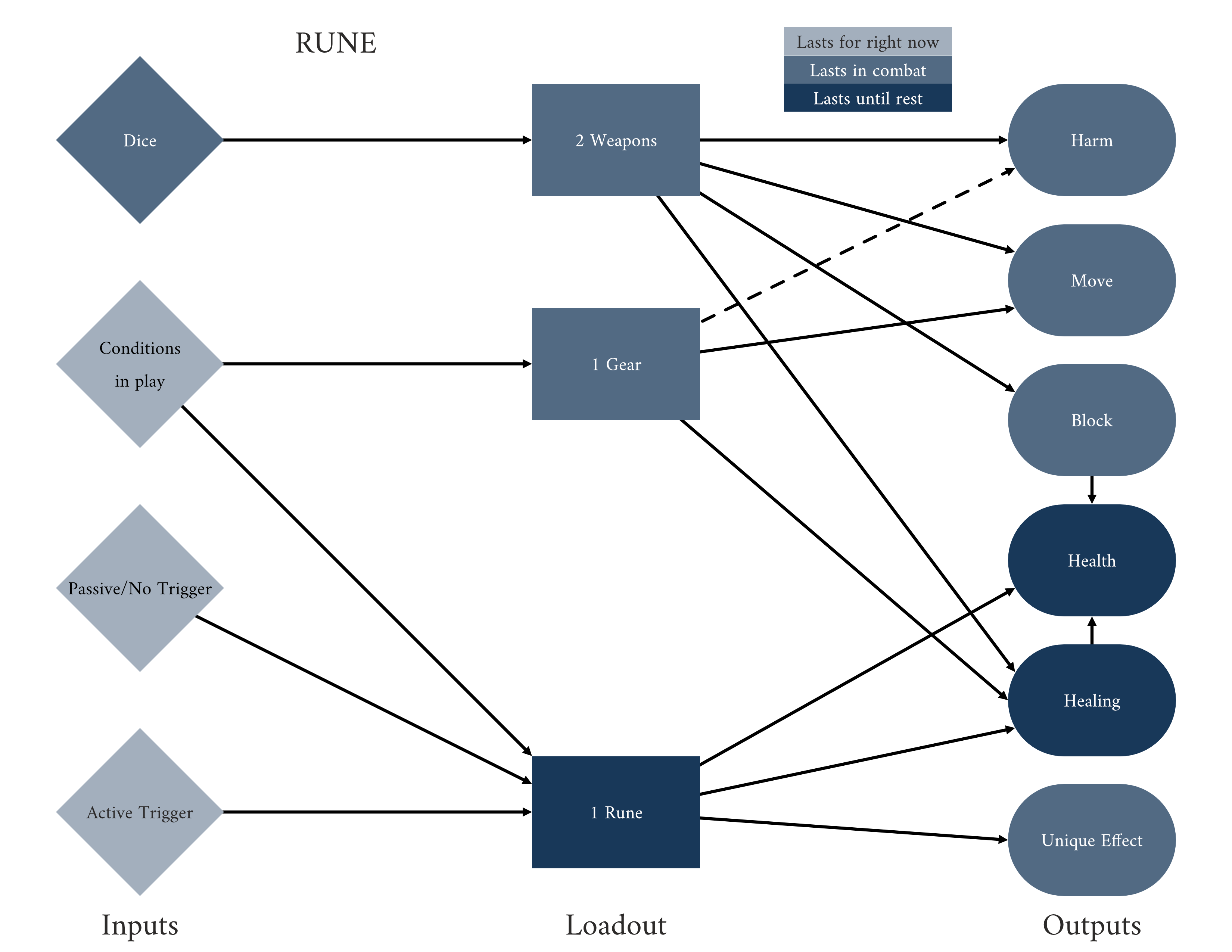
(Dashed lines mean indirect/optional, conditional, or requires a secondary input.)
There’s basically one proper resource and basically one kind of place to put that resource, and only Health and Runes are very persistent. So it’s a pretty simple diagram, especially compared to what’s coming later.
Let’s reverse this and look from the output perspective:
Usually only 1-2 loadout options can create a certain kind of output, and there’s not a 100% overlap. There’s also a lot more kinds of “lasts for right now”/passive inputs than direct resource inputs (which I’m noting here because this is going to come up later).
REAP bumps things up to 2 general kinds of resources, dice and viscera. (Viscera are technically 3 different things but they operate similarly enough so for the sake of not having these flowcharts be unintelligible, they’re lumped together). It now looks like:
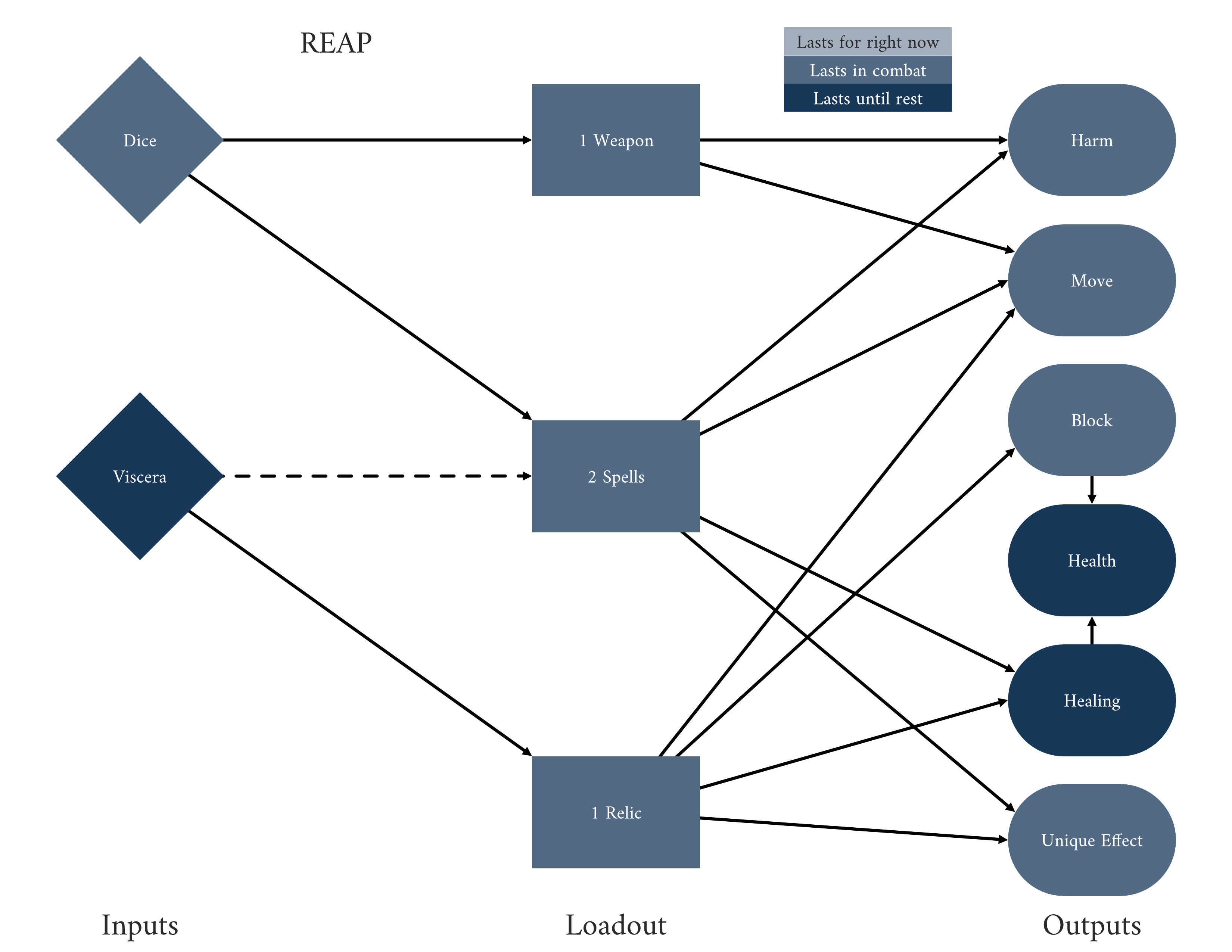
Reversing to look from outputs once again:
Remember how we noted there were a lot of passive/conditional inputs above? Well, everything is based on spending a resource here, long-term or short-term. But also, pay attention to how the resources are funneled. You need dice to do Harm: viscera can augment spells but there are no viscera-first spells. Relics are viscera-first and can keep you alive (which you do want) but can’t deal Harm, aka the thing you need to do to win fights (which you also want).
Now let’s move onto why I’m drawing the contrast specifically. VH Tactics has resources of dice and stamina. This doesn’t 100% tell the whole story, though: one kinds of thing (exclusively) take dice that rolled a 1 and some don’t unless you’re spending both dice on it. So effectively we have 3 resources: Dice (rolled a 1), Dice (2+), and Stamina. Notably also, there’s no healing and Health is intentionally very nebulous.
So we map that out and…
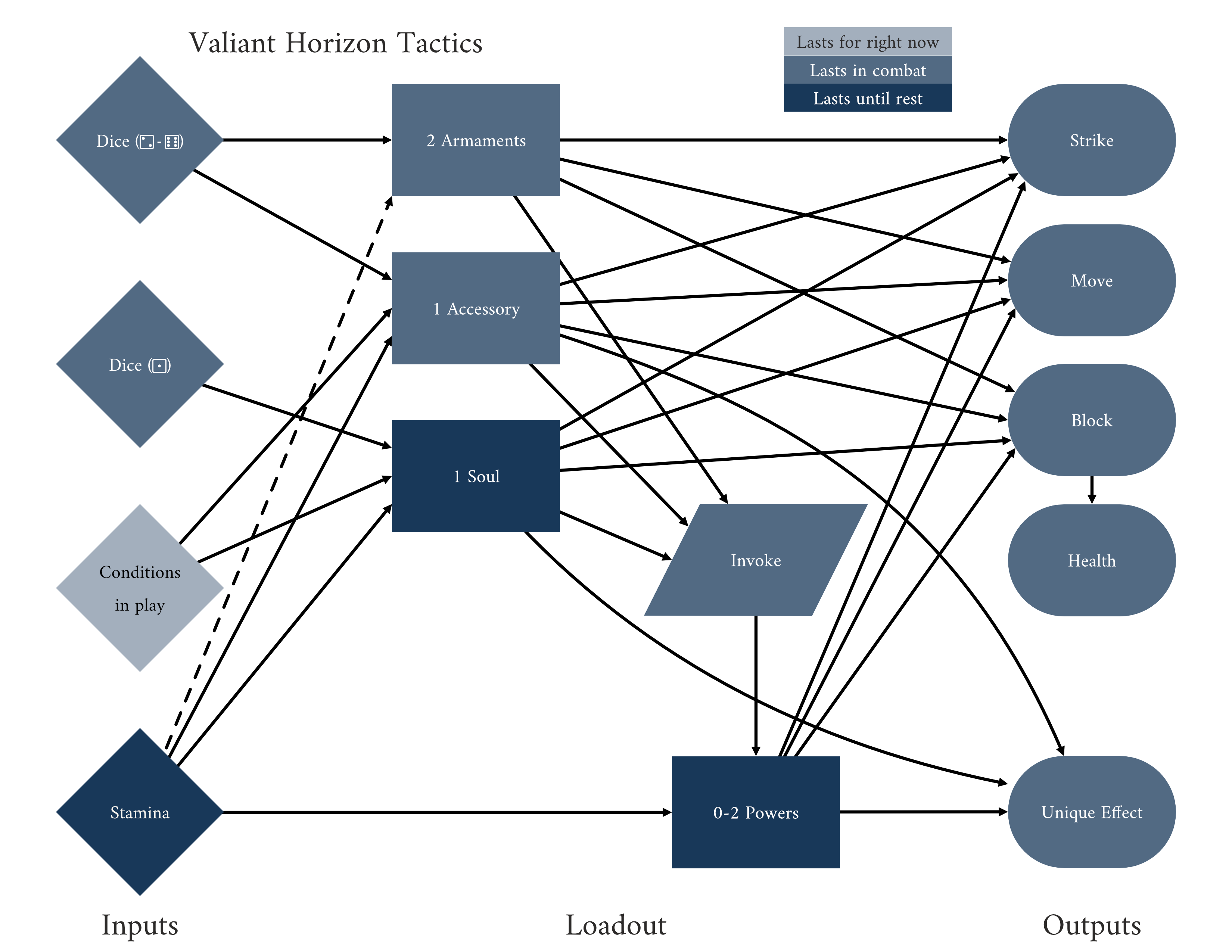
Well, this is a mess. Let’s break this down.
There’s a lot going on here, but the problem becomes more apparent when you approach it from the output side.
So basically everything can do basically everything. There’s no separation of concerns whatsoever. From the input side, dice get plugged into everything and also everything wants stamina. It’s a mess.
Now, I think it’s fine if multiple kinds of things can do something. I’m aiming for more baseline complication than RUNE/REAP so that’s inevitable. But for this new thing, I think we can untangle this a bit by using a few of the less obvious cues from RUNE/REAP:
So I’m considering the same kinds/amount of equipment as VHT: 2 weapons, 1 armor, 1 title, and 0-X spells. But let’s see what that looks like now:
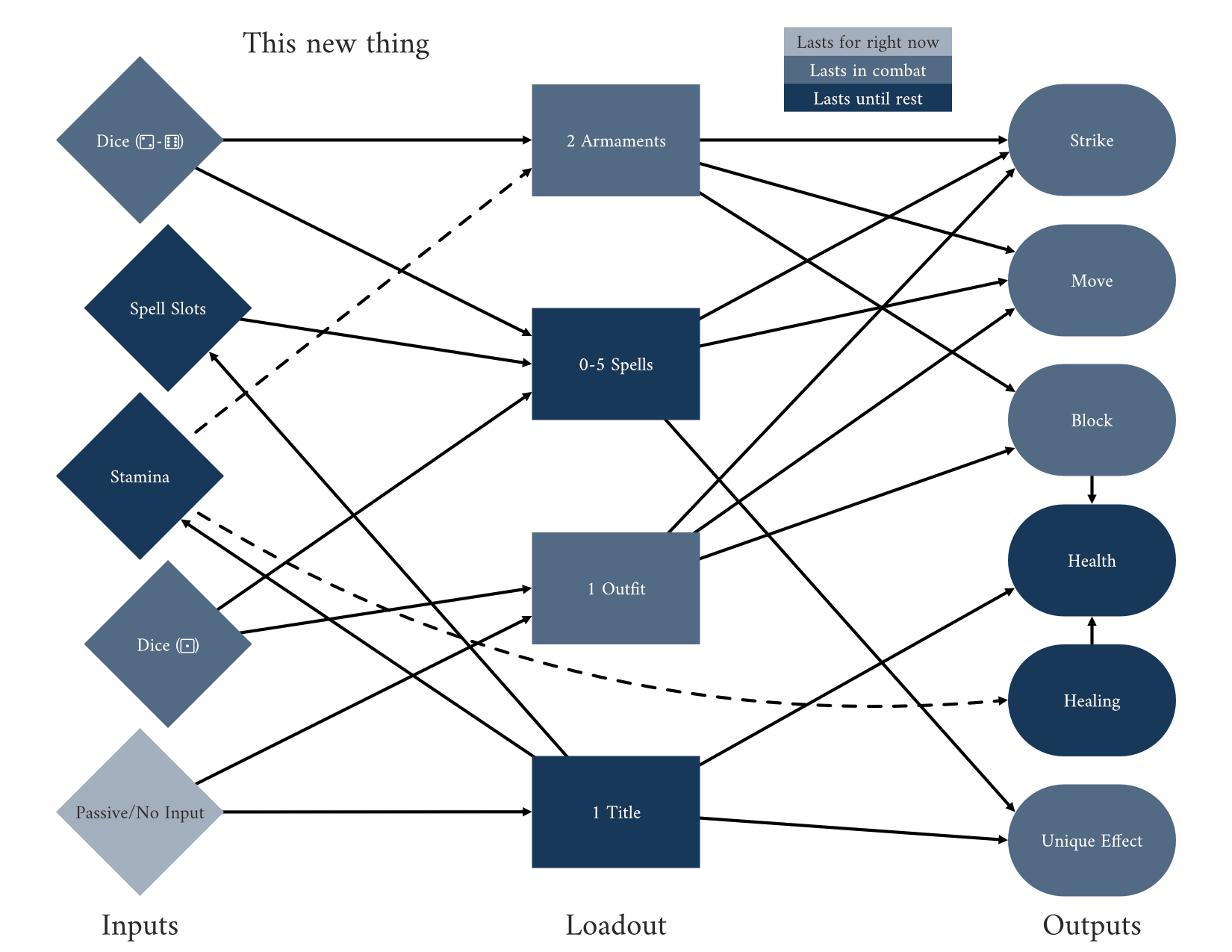
Still got a lot going on, but much more distributed and cleaner. Let’s break it down by loadout:
Now let’s look from the output side of things:
And from those inputs, the main thing is that all of the operative bits - strike, move, block - have to happen through dice. No exceptions. Other things can tweak them, but you have to use dice alongside them. There are intentionally no first-order uses of resources that don’t also go through dice (aside from like, passive stuff).
Now, don’t get too excited. Remember the Binary Star Promise up top. I have several things I do need to finish first, so this one gets to cook on the backburner on low. But I think I’ve got a better plan for this, at least, than I had before.
Here’s an idea, free to a good home: reverse this for a survival horror-ish game. You don’t have Health, but your opponents do - too much Health, if anything, unless you’ve got a breakable weapon or something that can run out of bullets. You have until I get another wild hair to execute on this. Get to it. ↩︎
As someone who went through every third-party RUNE realm available in late 2023: absolutely not (which is totally fine) ↩︎
My current big idea about how to gain spell slots is to rip off Outward (a game worth ripping off in many ways, but especially for this style of game). You can choose to expose yourself to magic directly by immersing yourself in a big stream of it. When you do, you gain 1 spell slot, but lose 1 max stamina and health (you start at 10 of each). You can find more streams until you’re capped at 5 slots, 5 max stamina, and 5 max health. (And keep in mind max stamina can be burned out of combat to restore health, so that compounds: 10 Health + Stamina means you’ve effectively got 20 Health to throw around, 5 Health + Stamina means you’ve got 10. That’s a huge decrease!) Schools of magic give you Titles that give you a freebie slot but only for their school: Pyromancer gives you one free spell slot for a fire spell, and so on. ↩︎
This is a noticeable break from RUNE/REAP and follows a trend from VHT: I want to be very intentional about Health because it’s the most obvious method of attrition. Being too loosey-goosey about it basically fully breaks the established attrition model, which is fine if you’re fine with it - I mean that’s intentionally what I did in VHT, and VH itself for that matter - but I do want it to matter a bit more here because we are making a more intentional Normalish Fantasy thing. Spells are the obvious choice to break this rule and provide healing but the main thing I’d worry about there is having a spell that restores Health effectively negate the slot/health/stamina tradeoff and therefore become the clear, dominant course of action. It might still happen but there would have to be some noticeable conditional aspect to it so I’m happy to call that an edge case. ↩︎
You can use your Bluesky account to reply to this post.
(Learn how this is implemented here.)